Start your free nasal index measurement scan
Full resolution
478 landmarks
During free scans, your photo stays on your device and is not uploaded to our server. All analysis happens in your browser. We keep only anonymous numerical, non-identifiable measurements, never your photo. See our privacy promise.
Alar width to nose height
Nasal index calculator: measure your nose width to height ratio
The nasal index is a classical anthropometric ratio comparing the width of the nose to its height. This free nasal index calculator uses an AI face scan to measure alar width and nasal height directly, alongside how nose width compares to overall face width.
Free basic reports require no credit card, no account, no password. Your image is never uploaded or stored. Analysis happens in your browser and your session data is cleared when you close or refresh the page.
In short
The nasal index is calculated by dividing nasal width, the distance between the outer edges of the nostrils, by nasal height, the distance from the bridge to the base of the nose, then multiplying by 100. Facemap also reports nose width as a proportion of total face width.
- 3D landmarks
- 4783D landmarks
- Scan time
- ~20sScan time
- Uploads, runs in browser
- 0Uploads, runs in browser
- No account required
- FreeNo account required
Where it is measured
Nasal index on the landmark mesh.
The overlay is drawn from the same 478 point MediaPipe landmark set Facemap uses on your own scan, so every caliper, axis and node sits on the exact anatomy the measurement is taken from.
Sample reading, Alar width to nose height


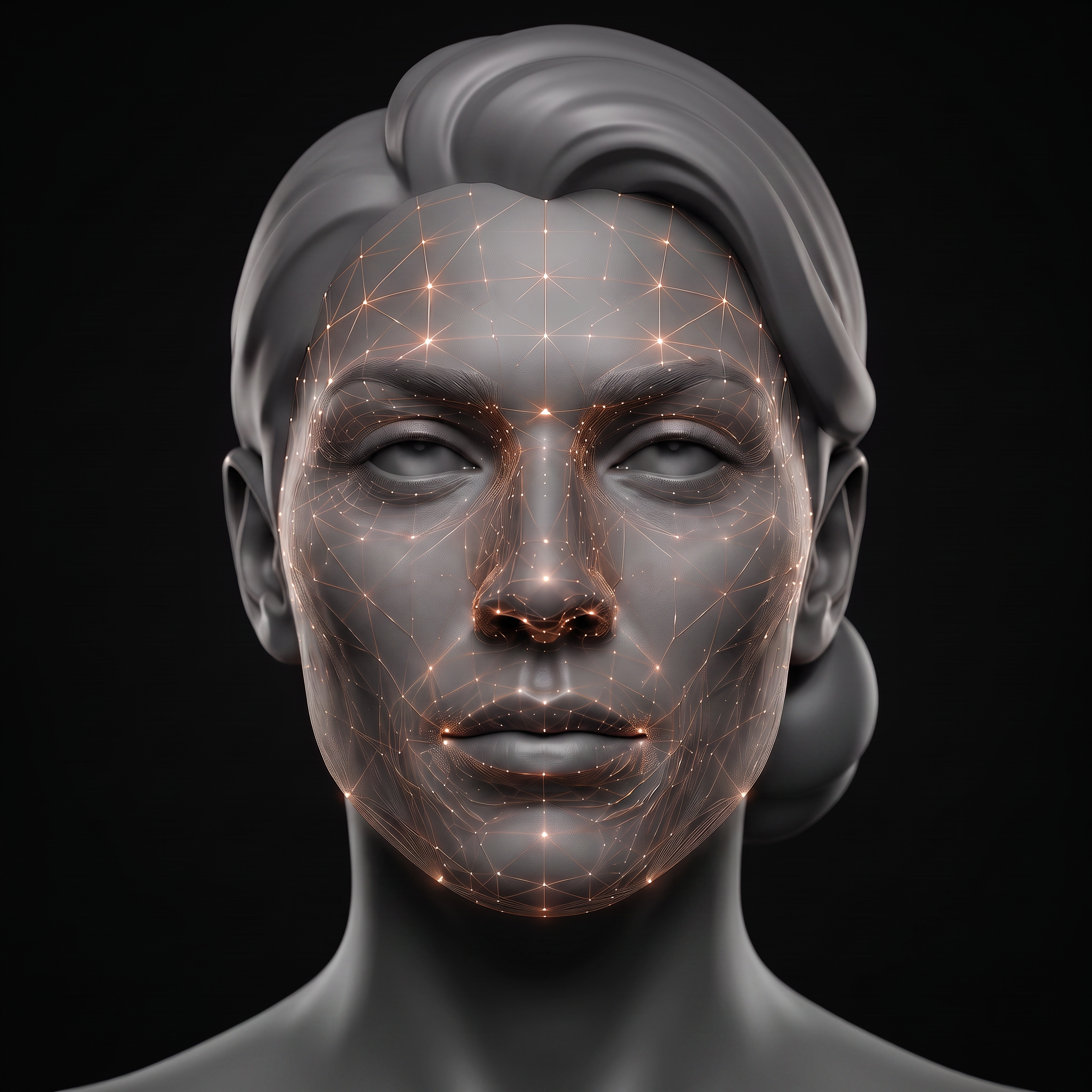
- Alar width
- 34.2 mm
- Nasal height
- 51.6 mm
- Nasal index
- 66.3
- Nose / face width
- 0.25
How the scan works
Capture
Guided front-on frame with even light, no upload.
Landmark
478 point mesh placed on your face in real time.
Report
Nasal index measured, normalised and explained.
What is nasal index?
A ratio of nasal width, the distance between the outer alar points at the widest part of the nose, to nasal height, the vertical distance from the nasion at the bridge to the subnasale at the base.
How Facemap measures nasal index
Facemap locates the alar points, nasion and subnasale from the 478-point mesh, calculates nasal width divided by nasal height as a percentage, and separately reports nasal width against total bizygomatic face width.
What the typical range looks like
Nasal index varies meaningfully and consistently across ancestry, so there is no single universal reference range. Facemap reports the measured value and its relationship to face width rather than scoring it against one fixed reference point.
How to read your result
Read nasal index alongside your face width, since the same nose width can read as narrow or wide depending on the overall face it sits within. Facemap therefore always pairs the ratio with the nose-to-face width figure.
The nasal index formula: how we calculate it
Nose width against nose height. Landmark numbers are MediaPipe Face Landmarker indices, and every distance is normalised to your own face so camera distance and image size cancel out.
dist(129, 358) / dist(168, 2)
- Landmarks used
- 129, 358, 168, 2
- Reference target
- 0.75
- Tolerance band
- 0.20
Your reading is compared with that published reference on a Gaussian match curve: score = round( 100 x exp( -0.5 x ( (reading - target) / tolerance )^2 ) ), clamped to 1 to 99. Basis for the reference value: classical anthropometric nasal index bands. The headline Attractiveness Score works differently: all readings are corrected for head angle and expression, weighted by confidence and mapped onto a 1 to 100 scale by a model calibrated against a published research set of more than Facemap scans.
Read the full Facemap methodology, including how the 22 measurement categories combine into your Attractiveness Score.
Nasal index reference table
Nasal index bands and how each reads.
- Below 70Leptorrhine
Narrower nose relative to its height
- 70 to 84Mesorrhine
The most commonly measured band
- 85 to 99Platyrrhine
Wider nose relative to its height
- 100 and aboveHyperplatyrrhine
Notably wide relative to height
How the nasal index is calculated
The ratio uses two measurements taken along and across the nose from a straight-on scan.
- Nasal width: outer left alar point to outer right alar point
- Nasal height: nasion at the bridge to subnasale at the base
- Nasal index equals nasal width divided by nasal height, times 100
Why nasal index varies by ancestry
Nasal index is one of the most studied anthropometric ratios precisely because it varies consistently and meaningfully across population groups, reflecting adaptation and inherited structure rather than any single reference proportion. Comparing your result against a single universal benchmark is therefore not meaningful, which is why Facemap reports the measured value on its own terms.
Nose width relative to face width
A nose can carry a typical nasal index while still reading as proportionally wide or narrow within a particular face, depending on overall face width. Facemap reports nose width as a percentage of bizygomatic face width alongside the classical index so both signals are visible together.
The nasal index formula, step by step
The formula is a straightforward division scaled to a whole number, which is why it has stayed the standard reference in anthropometry for over a century.
- Measure nasal width: outer left alar point to outer right alar point
- Measure nasal height: nasion at the bridge to subnasale at the base
- Divide nasal width by nasal height
- Multiply the result by 100 to get the nasal index
Your reading
Measure your nasal index in about twenty seconds.
The scan runs in your browser. Nothing is uploaded, and free basic reports need no account.
Questions
Nose width test: frequently asked questions
What is a normal nasal index?
There is no single normal value. Reported averages vary consistently by ancestry, and Facemap presents your measured value rather than scoring it against one universal range.
How is nasal index measured?
Nasal width, taken across the outer edges of the nostrils, divided by nasal height, taken from the bridge to the base of the nose, multiplied by 100.
Does nasal index relate to breathing or nose function?
No. Facemap measures external surface geometry only, and the nasal index is a structural descriptor, not a functional or medical assessment.
Why does nose width matter relative to face width?
The same absolute nose width reads differently depending on total face width, so Facemap reports both the classical nasal index and nose-to-face width together.
Is the nasal index calculator free?
Yes. The scan runs on-device with no account, and it is cleared from your browser when you leave the page.
What is the formula for the nasal index?
Nasal width divided by nasal height, multiplied by 100. Both distances are taken from the same straight-on scan.
How accurate is the nasal index AI face scan?
It uses Google's MediaPipe Face Mesh, a machine learning model that runs in your browser and places 478 3D landmarks on your face. Nothing is uploaded. The index comes from fixed geometry between those landmarks, not from a subjective opinion.
Related tools
Measurements that read alongside nasal index.
Free detector, test and styling guide
Face shape face scan
We compare face length, cheekbone width, forehead width, jaw width and jaw angle to classify your outline into one of five measured face-shape families.
Lip span vs alar width
Mouth to nose width face scan
We compare the width of your mouth at rest against the width of your nose at the widest point of the alar base, the classical proportion long associated with facial harmony.
Vertical proportion balance
Facial thirds face scan
The face is divided into three equal vertical zones: hairline to brow, brow to nose base, and nose base to chin. We measure how evenly your landmarks fall within each.
Every tool