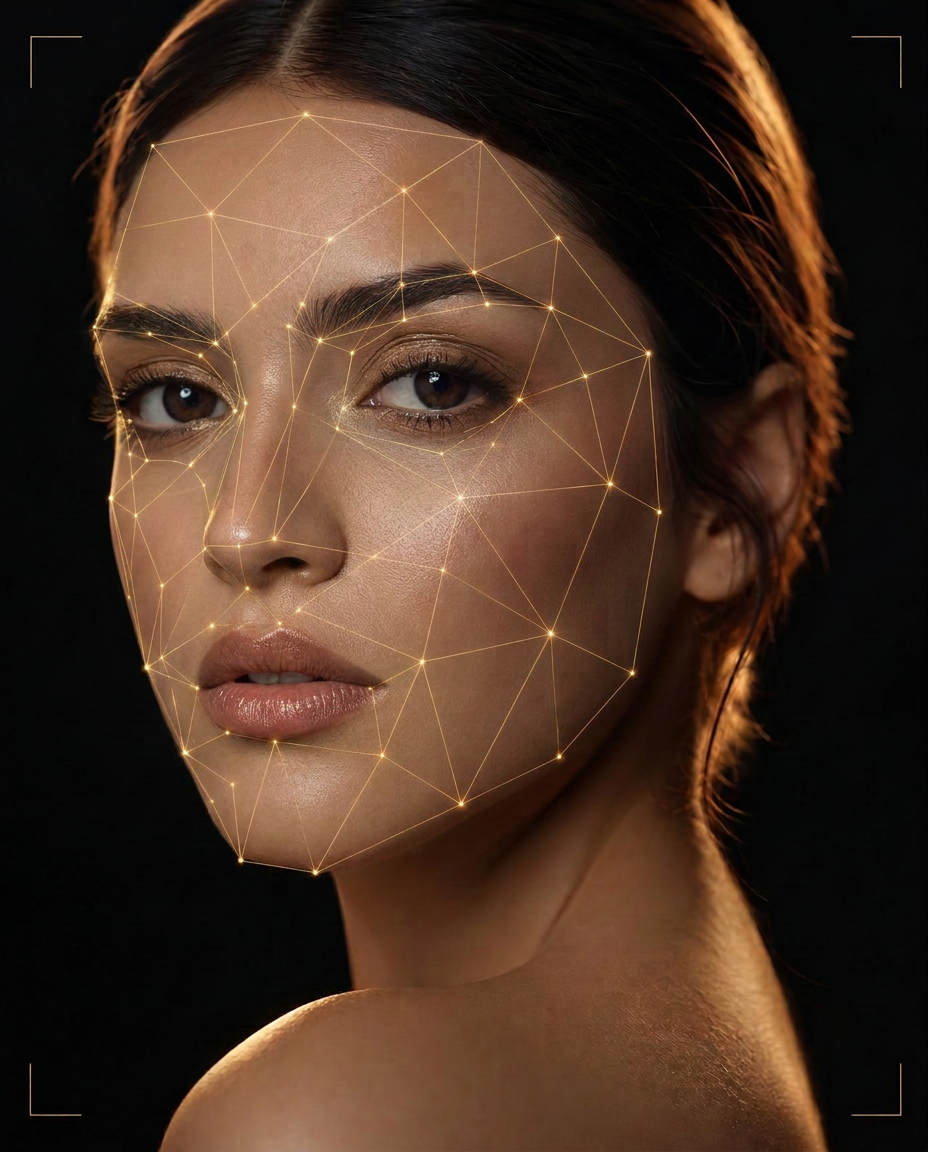
AI face measurements
Measure your face with instrument-grade AI.
Facemap places a 478-point three-dimensional landmark mesh over your face and runs over 1,600 calculations to produce 22 measurement categories across five groups, corrected for head angle and expression. Every reading arrives with reference ranges, method notes and plain-language meaning, and everything is computed in your browser.
- 3D facial landmarks mapped per scan
- 478
- Individual geometry measurements derived
- 22
- Measurement groups, eyes to full-face proportion
- 05
- Images uploaded. Analysis stays on your device
- 0
Eyes and brows
6 measurements
Canthal tilt
Eye-axis inclination angle
The upward or downward angle of the eye's outer corner relative to its inner corner, measured from the same 3D landmark set.
To learn more, visit Canthal tilt MeasurementEye spacing
Intercanthal distance ratio
The distance between the inner eye corners relative to the width of a single eye, a proportion that helps describe overall facial spacing.
To learn more, visit Eye spacing MeasurementEye to brow distance
Upper lid to brow gap
The vertical gap between your upper lash line and the lower border of your brow, normalised to your own eye height so the reading transfers across face sizes.
To learn more, visit Eye to brow distance MeasurementInterpupillary distance
Pupil to pupil distance in millimetres
The distance between the centres of your two pupils, reported in real millimetres by calibrating pixel distance against the near-constant diameter of the human iris.
To learn more, visit Interpupillary distance MeasurementEye size symmetry
Left vs right palpebral aperture
We compare the visible area and height of the left and right eye openings, the palpebral apertures, to check how closely they match in size.
To learn more, visit Eye size symmetry MeasurementEye aspect ratio
Palpebral fissure width vs height
We measure the width and height of the visible eye opening, the palpebral fissure, and use the relationship between them to describe eye shape as almond, round or narrow.
To learn more, visit Eye aspect ratio Measurement
Jaw and chin
3 measurements
Gonial angle
Jawline structure index
The angle at the back of the jaw, where the lower border meets the posterior border, a core index of lower-face definition.
To learn more, visit Gonial angle MeasurementJawline definition
Jaw contour, width and symmetry
A combined read on jaw contour sharpness, bigonial width, the ratio of jaw width to cheekbone width, and left to right jaw symmetry.
To learn more, visit Jawline definition MeasurementChin to philtrum
Lower-third proportion split
We split the lower third of your face into the philtrum, from the base of the nose to the upper lip, and the chin, from the lower lip to the chin point, then compare the two lengths.
To learn more, visit Chin to philtrum Measurement
Nose, lips and midface
4 measurements
Midface ratio
Width-to-height compactness
The ratio of midfacial width to midfacial height, derived from cheekbone and nasal landmarks to describe central-face compactness.
To learn more, visit Midface ratio MeasurementNasal index
Alar width to nose height
The nasal index compares the width of the nose at its widest point against its height, alongside how nose width relates to overall face width.
To learn more, visit Nasal index MeasurementMouth to nose width
Lip span vs alar width
We compare the width of your mouth at rest against the width of your nose at the widest point of the alar base, the classical proportion long associated with facial harmony.
To learn more, visit Mouth to nose width MeasurementLip ratio
Upper-lower vermilion balance
We measure the relative height of the upper and lower vermilion, the pigmented part of the lips, to arrive at a clear upper-to-lower balance.
To learn more, visit Lip ratio Measurement
Proportion and ratio
4 measurements
Facial thirds
Vertical proportion balance
The face is divided into three equal vertical zones: hairline to brow, brow to nose base, and nose base to chin. We measure how evenly your landmarks fall within each.
To learn more, visit Facial thirds MeasurementFacial fifths
Horizontal five-part width
We divide the width of your face into five vertical columns, each roughly one eye width, and compare the measured columns against the published reference range.
To learn more, visit Facial fifths MeasurementfWHR
Bizygomatic width to height
Facial width-to-height ratio compares the horizontal width of your cheekbones against the vertical height of your upper face.
To learn more, visit fWHR MeasurementFace shape
Oval, round, square, heart
We compare jaw width, cheekbone width, forehead width and total face length to classify your face shape from six common categories.
To learn more, visit Face shape Measurement
Symmetry
4 measurements
Facial symmetry
Bilateral landmark balance
We compare 478 corresponding landmarks across the vertical midline of your face, region by region, to quantify how closely each side mirrors the other.
To learn more, visit Facial symmetry MeasurementBrow symmetry
Height, arch and left/right balance
We measure brow height, the horizontal position of the arch peak, and compare both readings between your left and right brow to score overall brow balance.
To learn more, visit Brow symmetry MeasurementLip symmetry
Mouth corner and midline alignment
We compare the height of the left and right mouth corners, the offset of the cupid's bow, and the alignment of the lip midline against your facial axis.
To learn more, visit Lip symmetry MeasurementLip fullness
Vermilion height relative to face
We measure the visible vermilion height of your upper and lower lip against your total face height and mouth width to describe overall lip fullness.
To learn more, visit Lip fullness Measurement
See all 22 readings on your own face.
One scan, one minute, on your device. No account, no upload, no credit card.