Start your free facial fifths measurement scan
Full resolution
478 landmarks
During free scans, your photo stays on your device and is not uploaded to our server. All analysis happens in your browser. We keep only anonymous numerical, non-identifiable measurements, never your photo. See our privacy promise.
Horizontal five-part width
Facial fifths test: is your face divided into five equal widths?
The facial fifths reference divides the width of the face into five columns, each approximately one eye width, running from ear to ear. This free facial fifths test uses an AI face scan to measure each column from your own landmarks and reports how evenly they fall.
Free basic reports require no credit card, no account, no password. Your image is never uploaded or stored. Analysis happens in your browser and your session data is cleared when you close or refresh the page.
In short
The facial fifths test splits the horizontal width of your face into five vertical sections, each meant to equal one eye width. Facemap measures the distance between your ears, eyes and nose corners, then reports each of the five columns as a proportion of total face width.
- 3D landmarks
- 4783D landmarks
- Scan time
- ~20sScan time
- Uploads, runs in browser
- 0Uploads, runs in browser
- No account required
- FreeNo account required
Where it is measured
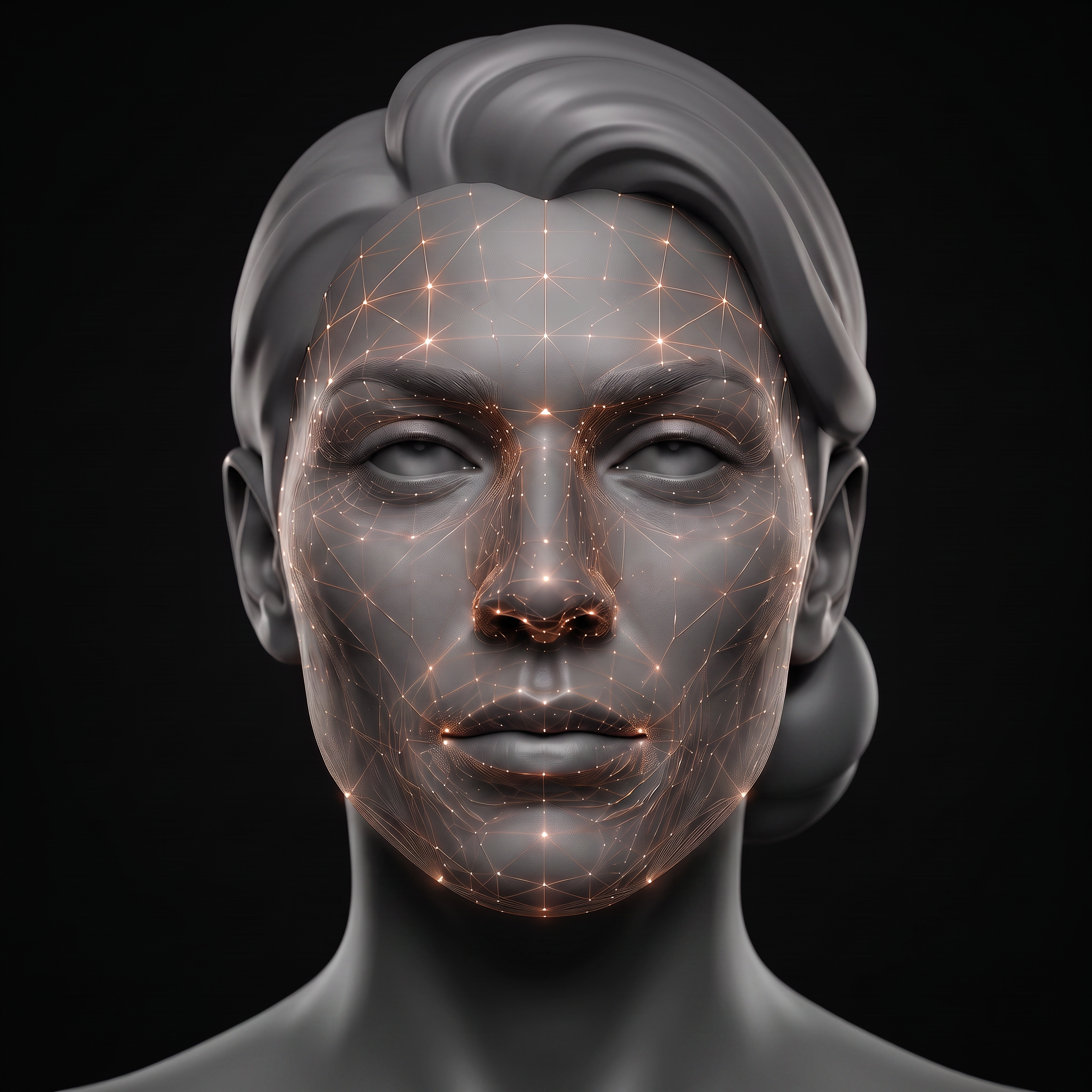
Facial fifths on the landmark mesh.
The overlay is drawn from the same 478 point MediaPipe landmark set Facemap uses on your own scan, so every caliper, axis and node sits on the exact anatomy the measurement is taken from.
Sample reading, Horizontal five-part width

- Mean fifth width
- 31.4 mm
- Widest fifth
- 32.7 mm
- Max deviation
- 4.2%
- Balance index
- 0.96
How the scan works
Capture
Guided front-on frame with even light, no upload.
Landmark
478 point mesh placed on your face in real time.
Report
Facial fifths measured, normalised and explained.
What is facial fifths?
A proportional division that splits total face width, ear to ear, into five columns: the width of each eye, the gap between the eyes, and the width from each outer eye corner to the nearer ear.
How Facemap measures facial fifths
Facemap locates the outer ear line, both inner and outer eye corners and the nasal base from the 478-point mesh, then expresses each of the five columns as a percentage of total face width so the comparison is scale independent.
What the typical range looks like
An even five-way split is the reference point, but most measured faces show one or two columns running slightly wider or narrower, usually the outer columns nearest the ear. That variation is normal and rarely visible without measurement.
How to read your result
Facemap reports each column separately rather than a single average, so you can see whether a wider or narrower column sits at the eyes, the intercanthal gap or the outer face. Read it alongside eye spacing for the fuller picture.
The facial fifths formula: how we calculate it
Evenness of the five vertical columns across face width. Landmark numbers are MediaPipe Face Landmarker indices, and every distance is normalised to your own face so camera distance and image size cancel out.
standard deviation of the five columns / their mean
- Landmarks used
- 234, 33, 133, 362, 263, 454
- Reference target
- 0, five equal columns
- Tolerance band
- 0.40
Your reading is compared with that published reference on a Gaussian match curve: score = round( 100 x exp( -0.5 x ( (reading - target) / tolerance )^2 ) ), clamped to 1 to 99. Basis for the reference value: published reference range for horizontal facial divisions. The headline Attractiveness Score works differently: all readings are corrected for head angle and expression, weighted by confidence and mapped onto a 1 to 100 scale by a model calibrated against a published research set of more than Facemap scans.
Read the full Facemap methodology, including how the 22 measurement categories combine into your Attractiveness Score.
Facial fifths reference table
Column deviation from an even fifth and how each reads.
- Within 2%Even
Columns close to the reference split
- 2 to 5%Balanced
The band most measured faces fall into
- 5 to 9%Uneven
One column, often outer, reads visibly wider
- Above 9%Distinctive
A clear horizontal proportion signature
The five columns of the facial fifths reference
Each column is measured independently from ear to ear, using the eyes and nose as internal reference points.
- Right ear to right outer eye corner
- Right outer eye corner to right inner eye corner
- Right inner eye corner to left inner eye corner
- Left inner eye corner to left outer eye corner
- Left outer eye corner to left ear
Why the fifths rarely land exactly even
The reference is a convention from classical portraiture, not a biological rule, so real skulls vary more than the diagram suggests.
- Orbital width varies independently of ear position
- Nasal base width shifts the middle three columns
- Head width at the ear is affected by camera angle if the scan is not front-on
- Ancestry and sex both shift typical proportions
Facial fifths versus facial thirds
Fifths describe horizontal balance, thirds describe vertical balance, and the two are independent measurements. A face can read evenly in one axis and unevenly in the other, so treat them as separate signals rather than one combined score.
The facial fifths formula, step by step
The formula behind this calculator expresses each of the five columns as a percentage of total face width, so the columns can be compared directly against an even one-fifth share regardless of how close or far you sit from the camera.
- Measure total face width from right ear to left ear
- Measure each of the five columns between the ear, eye and nose landmarks
- Divide each column's width by total face width
- Multiply by 100 to express each fifth as a percentage
- Compare each percentage against an even 20 percent share
Your reading
Measure your facial fifths in about twenty seconds.
The scan runs in your browser. Nothing is uploaded, and free basic reports need no account.
Questions
Facial fifths test: frequently asked questions
What are the facial fifths?
A classical convention that divides the horizontal width of the face into five columns, each intended to equal one eye width, measured from ear to ear.
Is an even five-way split necessary for a balanced face?
No. Most measured faces show mild unevenness in one or two columns, and this reference is a descriptive drawing aid rather than a biological standard.
How does Facemap measure facial fifths?
The scan locates your ear line, eye corners and nasal base from 478 3D landmarks, then expresses each column as a percentage of your total face width.
Do I need a side profile for this test?
No. A straight-on scan is sufficient, since all five columns are measured across the front of the face.
Is the facial fifths test free?
Yes. The scan runs on-device with no account and no upload, and results are not stored beyond the session.
What is the formula behind the facial fifths calculator?
Each column's width is divided by total face width and multiplied by 100, giving a percentage that is compared against an even one-fifth, or 20 percent, share.
How does the AI face scan measure my facial fifths?
Google's MediaPipe Face Mesh, a machine learning model, runs entirely in your browser and places 478 3D landmarks on your face. Nothing is uploaded. The five columns are then calculated from fixed geometry between those points, not from an opinion or a rating.
Related tools
Measurements that read alongside facial fifths.
Vertical proportion balance
Facial thirds face scan
The face is divided into three equal vertical zones: hairline to brow, brow to nose base, and nose base to chin. We measure how evenly your landmarks fall within each.
Intercanthal distance ratio
Eye spacing face scan
The distance between the inner eye corners relative to the width of a single eye, a proportion that helps describe overall facial spacing.
Bilateral landmark balance
Facial symmetry face scan
We compare 478 corresponding landmarks across the vertical midline of your face, region by region, to quantify how closely each side mirrors the other.
Every tool