Facemap
Cover
FacemapAesthetic Intelligence
Personal facial geometry report
83
Attractiveness Score, 1 to 100
Landmarks
478
Measurements
22
Face shape
Heart
Precision Aesthetic Intelligence
01 / 9
Sample of your PDF report
Facemap
Cover
Personal facial geometry report
83
Attractiveness Score, 1 to 100
Landmarks
478
Measurements
22
Face shape
Heart
Precision Aesthetic Intelligence
01 / 9
Facemap
01. Your Attractiveness Score
Your score comes from 478 mapped facial landmarks turned into 22 measurement categories. Every reading is corrected for head angle and expression, weighted by how reliable it is on your photo, then mapped onto a 1 to 100 scale by a model calibrated against a published research set of more than Facemap scans.
Against Facemap scans
Precision Aesthetic Intelligence
02 / 9
Facemap
02. Strongest, weakest, highest leverage
Your strongest feature
97/100
Gonial angle
The feature your scan rated highest. Lead with it: styling, lighting and angles that frame it do the most work for you.
Your weakest feature
63/100
Eye aspect ratio
The measurement pulling your overall score down hardest. Not a flaw, a target.
Your highest-leverage area
64/100
Eye size symmetry
Not your weakest, but the reading closest to its harmonious target. The smallest shift here lifts your overall score the most, and styling, lighting and camera angle can supply that shift.
Precision Aesthetic Intelligence
03 / 9
Facemap
03. Face shape
Classification
A wider forehead and cheekbones tapering to a narrower chin. Styles that add weight at the jaw and soften the brow line balance the taper.
Often referenced: Scarlett Johansson, Chris Hemsworth.
The five reference outlines
Oval
31%
Oblong
14%
Heart
18%
Square
21%
Round
16%
Percentages show how often each outline occurs across the Facemap scans. Yours is Heart, 18% of scans.
Hair and brows
Cuts, partings and brow shapes that balance your widest and narrowest points.
Frames and necklines
Glasses and collar shapes that either contrast or echo your outline.
Photo angles
The turn and tilt that read best for your shape on camera.
Precision Aesthetic Intelligence
04 / 9
Facemap
04. Symmetry, best side and Selfie Blueprint
Deviation = mirrored landmark distance / face width, per region.
Your best side
The right side leads by 3.2%.
Your right side carries marginally tighter symmetry through the cheek and jaw. Favouring it by a few degrees in photographs will read fractionally stronger.
Your Selfie Blueprint
Precision Aesthetic Intelligence
05 / 9
Facemap
05. Youth Signature
Your geometry leans strongly towards the proportions associated with a youthful read. Most of your youth markers are already working for you. Facemap does not estimate your age. This section reads the ten measurements that research links to a youthful or a more mature impression, and tells you which side each of yours falls.
Reading youthful
Jawline definition
96/100
A defined jaw border keeps the lower face crisp and youthful in outline.
Chin to philtrum
95/100
A short philtrum against the chin is strongly linked to a youthful lower face.
Midface ratio
94/100
A compact midface keeps the centre of the face reading fresh and lifted.
Nasal index
93/100
Nasal proportions sit within the range that keeps the midface balanced.
Facial thirds
91/100
Evenly balanced thirds hold the face in proportions associated with youth.
fWHR
89/100
Your width-to-height ratio keeps the face compact rather than elongated.
Lip fullness
85/100
Fuller lip volume relative to face height is a classic youth marker.
Adding maturity
Eye aspect ratio
63/100
A narrower aperture reads calmer and more mature.
Eye to brow distance
65/100
A lower brow-to-eye distance closes the frame and reads more mature.
Canthal tilt
67/100
A flatter or negative tilt reads as a more settled, mature eye line.
Precision Aesthetic Intelligence
06 / 9
Facemap
06. Facial proportion ranking
Every measurement is matched against its published reference range. The readings at the top sit closest to the middle of that range; the ones further down are where your proportions move furthest from it, or shift most with styling and angle.
Precision Aesthetic Intelligence
07 / 9
Facemap
07. Your annotated scan
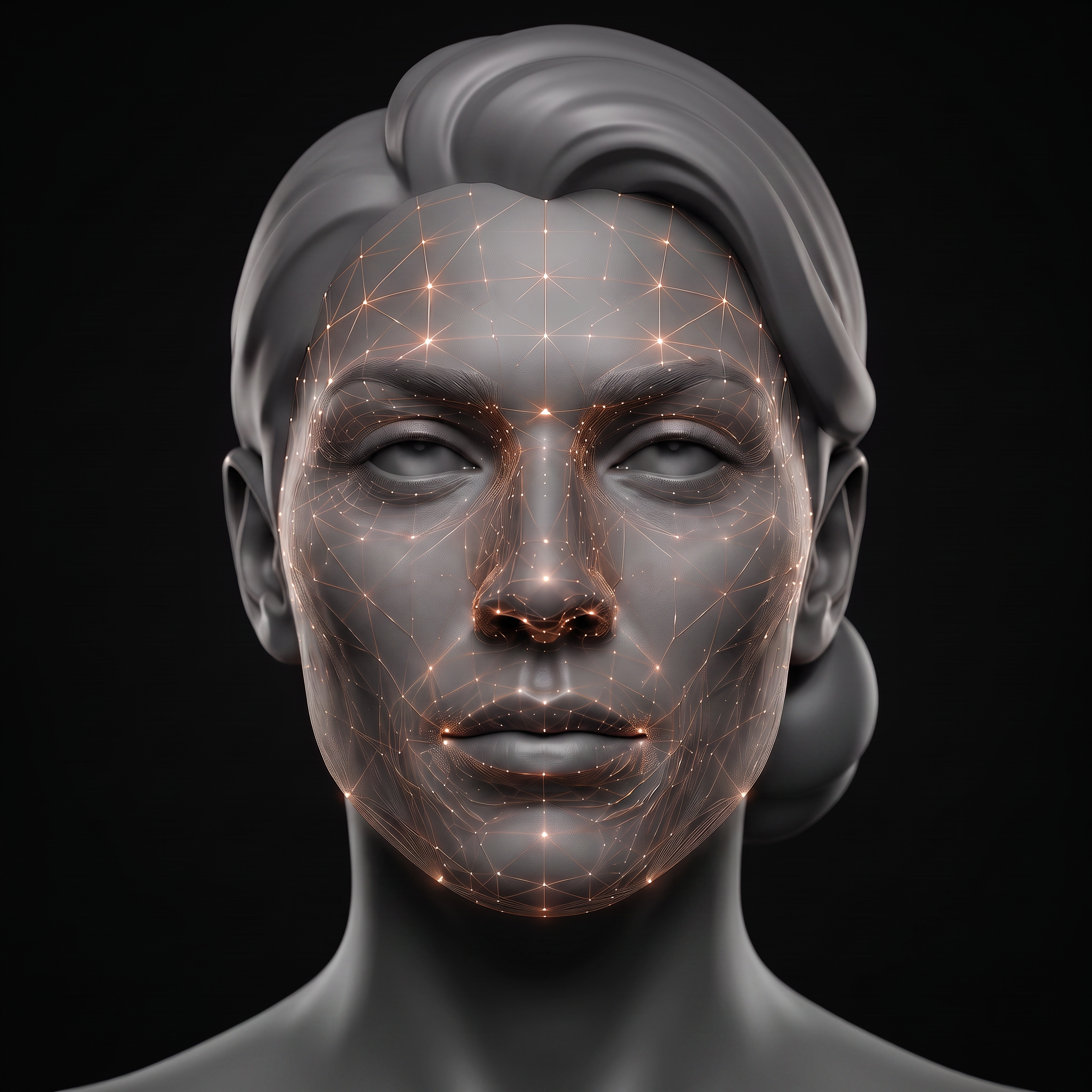
478 landmarks
Your report overlays the full 478-landmark mesh and contour field on your captured frame, with each of the 22 measurement zones labelled. Yours to keep, and to compare against every future re-scan.
Precision Aesthetic Intelligence
07 / 9
Facemap
08. Your Personal Style Compass
Every recommendation below is drawn from your measured geometry and from the published styling literature on face shape, proportion and framing. Nothing here is AI generated, nothing here is medical advice, and none of it asks you to change your anatomy. These are the levers that change how your existing geometry reads.
Hair is the single largest lever you have, because it changes the outline used in almost every proportional measurement. These are the shapes that suit a heart outline.
What suits you
Weight and movement at the jaw: chin-length bobs, lobs with soft ends, and side-swept fringes that reduce apparent forehead width.
Face shape: Heart.
What to be careful with
Very short pixies with all volume at the crown, and slicked-back styles that expose the full forehead width against a narrow chin.
Face shape: Heart.
Parting
A deep side parting balances the wider upper third.
Derived from your symmetry and facial thirds readings.
Grooming levers are small in effort and disproportionately large in effect, because they act directly on the landmarks the scan measures.
Brow architecture
Set the arch peak above the outer edge of the iris, groom the underside rather than thinning the top edge, and keep the tail no lower than the head of the brow. This one change moves brow symmetry, brow-to-eye distance and canthal tilt readings at the same time.
Brow position feeds three of your 22 measurements.
Skin surface and light return
Even tone and a satin, not matte and not glossy, finish let the light model your cheekbones. Heavy matte finishes flatten the midface and remove the shadow that defines the jaw border.
Surface finish changes how strongly your contour reads under any light.
Placement of emphasis
Emphasis high on the cheekbone shortens the midface read. Emphasis low widens and lengthens it. Choose according to your midface ratio score.
Derived from your midface ratio and cheekbone geometry.
Frames sit across your strongest horizontal line, so shape and depth matter more than colour.
Frame guidance
Bottom-heavy or rimless-bottom frames add visual weight low in the face. Light colours and thin temples keep the upper third from widening. Avoid heavy top bars and cat-eye shapes.
Face shape: Heart.
Frame width
Keep the outer edge of the frame level with the widest point of your face. Wider frames add facial width, narrower frames make the face read longer.
Derived from your facial width-to-height ratio.
What sits under the jaw sets the frame the whole face is read against.
What to wear at the neck
Sweetheart and scoop necklines echo the taper; adding a collar or a soft scarf gives the jaw more visual weight.
Face shape: Heart.
Ranked from your own lowest readings. None of these change your anatomy; each changes how a specific measured reading is perceived.
Eye aspect ratio
Lash and lid definition and a rested, unsquinted expression open the aperture. Under-eye brightness increases the apparent opening more than lash volume does.
Scored 63 of 100, one of your lowest readings.
Eye size symmetry
Uneven eye aperture is usually driven by lid position and habitual squint on one side. Even, straight-on lighting reduces the apparent difference more than anything cosmetic.
Scored 64 of 100, one of your lowest readings.
Eye to brow distance
Brow height is one of the most adjustable readings you have. Grooming the underside of the brow rather than the top edge raises the apparent lid space; letting the brow grow low closes it.
Scored 65 of 100, one of your lowest readings.
Interpupillary distance
Fixed anatomy. Frame width and brow spacing are the levers that change how it reads, not the measurement itself.
Scored 65 of 100, one of your lowest readings.
Eye spacing
Emphasis placed on the inner or outer corner shifts perceived spacing: inner-corner brightening pulls close-set eyes apart visually, outer-corner emphasis draws wide-set eyes together.
Scored 66 of 100, one of your lowest readings.
Your strongest readings. Style to show these, not to hide them.
Gonial angle
Measured values commonly sit in a broad band around 120 degrees, with a strong sex and ancestry component. A surface scan estimates soft-tissue geometry, not bone, so treat it as an index rather than a clinical figure.
Scored 97 of 100.
Jawline definition
There is no universal target, since jaw structure varies widely and is strongly influenced by bone shape, muscle mass and soft tissue thickness. A narrower jaw-to-cheek ratio tends to read as a tapered, heart-shaped lower face, while a ratio closer to one reads as a squarer lower face. Sharper contour scores generally correspond to a more visually defined jaw edge under any lighting.
Scored 96 of 100.
Chin to philtrum
A commonly referenced target is a philtrum to chin ratio near 1:2, though considerable natural variation exists across bone structure and lip fullness. The reading is descriptive, not a target to chase, and works best alongside the wider facial thirds breakdown.
Scored 95 of 100.
Precision Aesthetic Intelligence
08 / 9
Facemap
09. All 22 geometric measurements
Each entry shows exactly how the number was produced, what your scan recorded, how that scores from 1 to 100, and what it means in plain English.
score = round( 100 x exp( -0.5 x ( (reading - target) / tolerance )^2 ) ), clamped to 1 to 99
Most faces measure between roughly neutral and a few degrees positive. Larger positive angles read as alert and lifted, negative angles read as soft and downturned, and neither is a fault. Your reading is developing. This reading sits outside the harmonious reference band and is one of the places your overall score loses ground. The action plan shows the levers that move it.
A ratio near one matches the classical one-eye-width reference. Wider and narrower spacing are both common and both read as distinctive rather than incorrect. Your reading is developing. This reading sits outside the harmonious reference band and is one of the places your overall score loses ground. The action plan shows the levers that move it.
There is no single correct gap. A smaller ratio is typical of hooded or deep-set eyes, where the brow sits close to the lid, and a larger ratio is typical of an open eyelid with more visible lid space. Both are common structural variants rather than a defect. Your reading is developing. This reading sits outside the harmonious reference band and is one of the places your overall score loses ground. The action plan shows the levers that move it.
Adult interpupillary distance typically falls between 54 and 68 millimetres, with the average sitting close to 63 millimetres. There is no better or worse value, it is simply a fixed structural measurement used mainly for practical fitting purposes. Your reading is developing. This reading sits outside the harmonious reference band and is one of the places your overall score loses ground. The action plan shows the levers that move it.
A small difference between the two eyes is near universal and is rarely noticeable in daily life. The reading is most useful as a description of your own structure, not as a comparison against anyone else's face. Your reading is developing. This reading sits outside the harmonious reference band and is one of the places your overall score loses ground. The action plan shows the levers that move it.
There is no single correct eye aspect ratio, shape is a description rather than a score. Almond, round and narrow shapes each fall within recognised ranges, and the reading is most useful for understanding your own baseline shape rather than comparing against another face. Your reading is developing. This reading sits outside the harmonious reference band and is one of the places your overall score loses ground. The action plan shows the levers that move it.
Measured values commonly sit in a broad band around 120 degrees, with a strong sex and ancestry component. A surface scan estimates soft-tissue geometry, not bone, so treat it as an index rather than a clinical figure. Your reading is exceptional. This is one of the standout readings in your scan, sitting well inside the range our reference data associates with high harmony.
There is no universal target, since jaw structure varies widely and is strongly influenced by bone shape, muscle mass and soft tissue thickness. A narrower jaw-to-cheek ratio tends to read as a tapered, heart-shaped lower face, while a ratio closer to one reads as a squarer lower face. Sharper contour scores generally correspond to a more visually defined jaw edge under any lighting. Your reading is exceptional. This is one of the standout readings in your scan, sitting well inside the range our reference data associates with high harmony.
A commonly referenced target is a philtrum to chin ratio near 1:2, though considerable natural variation exists across bone structure and lip fullness. The reading is descriptive, not a target to chase, and works best alongside the wider facial thirds breakdown. Your reading is exceptional. This is one of the standout readings in your scan, sitting well inside the range our reference data associates with high harmony.
Lower ratios read as compact, higher ratios read as elongated. Both are common, and the full report plots your figure against the Facemap reference set. Your reading is exceptional. This is one of the standout readings in your scan, sitting well inside the range our reference data associates with high harmony.
Nasal index varies meaningfully and consistently across ancestry, so there is no single universal reference range. Facemap reports the measured value and its relationship to face width rather than scoring it against one fixed reference point. Your reading is exceptional. This is one of the standout readings in your scan, sitting well inside the range our reference data associates with high harmony.
The classical reference figure sits close to 1.618, the proportional balance, though measured faces show a wide spread around this figure and no single value indicates better or worse structure. The ratio is most useful as a stable, repeatable reading rather than a score to optimise. Your reading is exceptional. This is one of the standout readings in your scan, sitting well inside the range our reference data associates with high harmony.
Classical references cite roughly one to one and a half, upper to lower. Measured faces spread widely on either side of that. Your reading is exceptional. This is one of the standout readings in your scan, sitting well inside the range our reference data associates with high harmony.
Evenly distributed thirds are a classical reference point, not a requirement. A longer lower third, for example, is a common and often striking structural signature. Your reading is exceptional. This is one of the standout readings in your scan, sitting well inside the range our reference data associates with high harmony.
An even five-way split is the reference point, but most measured faces show one or two columns running slightly wider or narrower, usually the outer columns nearest the ear. That variation is normal and rarely visible without measurement. Your reading is exceptional. This is one of the standout readings in your scan, sitting well inside the range our reference data associates with high harmony.
Reported averages across studies typically sit between 1.6 and 2.1, with meaningful overlap between individuals. A higher fWHR is not inherently more or less typical, it simply describes a wider face relative to its upper height. Your reading is exceptional. This is one of the standout readings in your scan, sitting well inside the range our reference data associates with high harmony.
No shape is more correct than another, and the classification is descriptive rather than evaluative. Oval, round, square, heart, diamond and oblong all occur naturally and in roughly comparable frequency across populations. Your reading is exceptional. This is one of the standout readings in your scan, sitting well inside the range our reference data associates with high harmony.
No face is perfectly symmetrical, and near-perfect symmetry reads as uncanny rather than attractive. Most measured faces fall within a narrow band of small deviations, and the useful signal is which region carries the difference, not the headline number. Your reading is strong. A strong reading, comfortably inside the harmonious reference band and a genuine asset to your overall score.
Small brow height and arch differences of a few millimetres are extremely common and usually not visible in a mirror. Larger differences, particularly in arch peak position, are more likely to be noticeable and are the most common source of a perceived uneven brow. Your reading is strong. A strong reading, comfortably inside the harmonious reference band and a genuine asset to your overall score.
A small difference in mouth corner height is normal and often relates to habitual expression on one side of the face. The reading is most informative as three separate figures rather than a single combined score, since each one can vary independently. Your reading is strong. A strong reading, comfortably inside the harmonious reference band and a genuine asset to your overall score.
There is a wide range of lip proportions across faces that are considered balanced, and fullness reads differently depending on mouth width and the ratio between upper and lower lip. The figure is descriptive rather than a target to aim for. Your reading is strong. A strong reading, comfortably inside the harmonious reference band and a genuine asset to your overall score.
Precision Aesthetic Intelligence
09 / 9
Sample report shown with demonstration data. Your report is generated from your own scan, delivered as a downloadable PDF, and covered by a 7-day money-back guarantee. Photographs from free scans are never uploaded or stored; they are cleared from your browser when you leave the page and are never sold or used for AI training. Read the full scoring methodology.